Davido Lied About Tagbo's Death, Re-invited For Questioning By Police

The police in Lagos have said that Tagbo Umeike, the late friend of music artist, Davido, actually died from suffocation, and not alcohol poisoning that was originally reported. 
The police commissioner, Imohimi Edgal, stated this at a briefing in Lagos on Wednesday afternoon, where he announced that Davido has been re-invited for questioning after he lied to police.
Mr. Edgal said Davido has been re-invited for questioning because he lied that he only knew of Tagbo’s demise while he was at DNA nightclub, in Victoria Island, a claim that has been found to be untrue.
According to Mr. Edgal, the autopsy report revealed that Tagbo died from suffocation, adding that Davido’s driver and two of his friends abandoned him in his car at the hospital.
Tagbo reportedly died on the eve of his birthday on Tuesday at a bar in the Lekki area of the state. Two other associates of the singer – DJ Olu, 25, and Chime Amaechi – were found lifeless in the former’s BMW car parked in the underground garage of Block B, Banana Island, Lagos on Saturday, three days after Tagbo’s death.

President Buhari Approved N640 billion Oil Contracts From His Sickbed In London, NNPC Chief Baru Indicates

President Muhammadu Buhari was granting approvals for oil deals to the Nigerian National Petroleum Corporation during the time he was on his sick bed in London – and when he had relinquished presidential powers to his Vice President – the head, Maikanti Baru, has indicated.
Mr. Baru said Mr. Buhari approved at least two separate oil contracts on July 10 and July 31 worth $1 billion and $780 million, respectively.
The N640.8 billion contracts (at N360/$ exchange rate) were approved when Mr. Buhari was receiving treatment for undisclosed ailments in London, and when he was not supposed to be exercising presidential powers, having named Vice President Yemi Osinbajo acting president in a formal correspondence to the National Assembly.
Mr. Buhari was flown to London on May 7, barely two months after he returned from his first 2017 medical vacation which saw him spend 50 days in the United Kingdom.
On May 9, a letter Mr. Buhari wrote to the Speaker of the House of Representatives and President of the Senate notifying them that he had relinquished presidential authorities in accordance with the Nigerian Constitution was read on the floor of both chambers.
Despite rumors of his early return, Mr. Buhari ultimately spent 103 days receiving treatment in London, returning on August 19.
On August 21, the president notified the National Assembly of his return in writing, saying he had “resumed” his “functions as the President of the Federal Republic of Nigeria with effect from Monday, 21st August, 2017.”
THE CONTRACTS
But on Monday, Mr. Baru revealed that Mr. Buhari had been exercising presidential powers by granting approvals for NNPC joint venture contracts when he was supposedly on his sickbed and not exercising presidential powers.
Mr. Baru gave details of the contracts as follows:
S/N PROJECT  Amount (US$mn)  APPROVALS   LOAN EXECUTED BY
NTB PRESIDENTIAL
1. NNPC/CNL JV Project Cheetah 1200 16/04/15 01/09/15 Dr. E. I. Kachikwu
2. NNPC/CNL JV Project Falcon 780 26/04/17 31/07/17 Dr. M. K. Baru
3. NNPC/SPDC JV Project Santolina 1000 26/04/17 10/07/17 Dr. M. K. Baru

TOTAL 2980
(CNL refers to Chevron Nigeria Limited, SPDC to Shell Petroleum Development Company and JV to Joint Venture).
The disclosures were made when the NNPC responded – on behalf of Mr. Baru – to the allegations of contract fraud and insubordination raised by Ibe Kachikwu.
Mr. Kachikwu, the Minister of State for Petroleum Resources, had in an August 30 memo to Mr. Buhari said Mr. Baru unilaterally approved contracts without recourse to him or the NNPC board, amongst other concerns. The memo surfaced on social media on October 3, sending ripples through the country’s polity.
On October 9, the NNPC responded to Mr. Kachikwu’s allegations by publishing the above contract details, which it said was at the instance of Mr. Buhari, who had kept mum since the scandal broke.
But a look at the dates of the three contracts shows that two of them received presidential approval on dates Mr. Buhari was not in the country, July 31 for the second contract with Chevron Nigeria and July 10 for the contract with Shell. Mr. Baru’s name was placed against the contracts as the person who administered the contract in his capacity as the Group Managing Director of the NNPC.
Only the September 1, 2015, contract which Mr. Kachikwu oversaw during his tenure as the GMD of NNPC received presidential approval on a date Mr. Buhari was in the country and wielding presidential powers.
A compilation of Mr. Buhari’s travels reveals that he was in the country from early August 2015 when he returned from Cotonou until September 7 when he visited Accra.
But while it is clear that the presidential approval granted when Mr. Kachikwu was the head of NNPC happened when Mr. Buhari was exercising presidential powers; it appeared like Mr. Baru received his approval when Mr. Buhari was in London.
GETTING OSINBAJO’S CONSENT
In his memo to Mr. Buhari, Mr. Kachikwu stated that when Mr. Buhari was unwell in London for several months between May and August, Mr. Baru tried to get direct approval from Acting President Osinbajo for some personnel changes at the NNPC.
But Mr. Osinbajo asked Mr. Baru to go back to Mr. Kachikwu and get his input and approval first before making the changes. Mr. Baru refused to consult Mr. Kachikwu on that.
For weeks, the changes were not made, until Mr. Buhari returned on August 19. By August 29, Mr. Baru announced the changes.
This prompted Mr. Kachikwu’s letter to the president on August 30, complaining that he learnt of the development in the media.
Sources at the presidency corroborated Mr. Kachikwu’s claim that Mr. Osinbajo rebuffed Mr. Baru’s attempts to get presidential approval behind Mr. Kachikwu.
Neither the vice president’s office nor Mr. Baru also denied that claim by Mr. Kachikwu.
It is not immediately clear if Mr. Baru also attempted to get approval for the multi-billion dollar contracts from Mr. Osinbajo. But presidency sources said it was unlikely that Mr. Osinbajo, who did not allow Mr. Baru to make personnel changes, would allow the NNPC GMD to circumvent Mr. Kachikwu with such high-profile contracts.
Ndu Ughamadu, the spokesperson for the NNPC, would not confirm or deny if Mr. Baru got the approval from Mr. Buhari in London.
“Presidential approval is presidential approval,” Mr. Ughamadu said.
When PREMIUM TIMES reminded him of potential legal implications of Mr. Buhari exercising presidential powers even when he had relinquished same in accordance with the constitution, Mr. Ughamadu dug his heels in.
“Presidential approval is presidential approval,” the spokesperson insisted.
For several hours on Tuesday, presidential spokespersons Femi Adesina and Garba Shehu, did not respond to PREMIUM TIMES’ requests seeking their comments about this and other problematic parts of the NNPC revelations.
Sola Adebawo, Director of Communications at Chevron, did not immediately respond to PREMIUM TIMES’ requests for comments Tuesday evening. His counterpart at Shell Nigeria, Bamidele Odugbesan, simply told PREMIUM TIMES to “direct inquiries to relevant government authorities.”
Yet, the N640.8 billion oil contracts might not be the only one Mr. Baru got Mr. Buhari to approve while he was still unwell in London.
For instance, the NNPC announced on February 2 ‎that it received 128 bids from local and international firms willing to participate in its 2017-2018 Direct-Sale–Direct-Purchase crude programme, which was adopted by the Buhari administration last year to replace the crude oil swap initiative and the offshore processing arrangement.
Mr. Buhari was not around in on February 2 when the announcement was made, having been flown to London on January 19 for his first medical trip of the year. He didn’t return to the country until March.
On May 19, when NNPC sources told Daily Trust and a few other media houses that it had finally entered into a $6 billion deal with 10 companies for 2017-2018 edition of DSDP contracts, Mr. Buhari was also not in the country.‎
The NNPC spokesperson declined comments about DSDP contracts.
LEGAL EXPERT WEIGHS IN
Mr. Kachikwu previously doubled as the Minister of State for Petroleum and GMD of NNPC until he was relieved of the latter post by Mr. Buhari on June 4, 2016, the same day Mr. Baru was named as a replacement.
When Mr. Buhari named Mr. Baru the GMD, he made Mr. Kachikwu the chairman of the NNPC board.
The NNPC Act designates the board to oversee the affairs of the state-owned oil giant.
The Act states that the Minister of Petroleum must be the chairman of the NNPC board. Mr. Buhari is the substantive Minister of Petroleum. But he is allowed by the NNPC law to delegate powers, including chairmanship of the board.
However, the law also allows Mr. Buhari to act concurrently as the chairman of NNPC board even while the appointment of the person he delegated powers to is still valid.
Legal analyst, Liborous Oshoma, said the president’s action may be “unprocedural” but might not be entirely illegal.”
“This is similar to what we have witnessed since the president was away yet he was still issuing presidential statements and taking calls from President Donald Trump and other presidents to discuss matters concerning Nigeria.
“All that happened despite the fact that we had an acting president in place and Nigerians raised concerns at the time,” Mr. Oshoma said.
He said Mr. Buhari might not be in a good state of mind when the presidential approvals were procured and their validity could be challenged in court.
“The contracts could be challenged and possibly rendered invalid by the courts because he didn’t have presidential powers at the time he was exercising same,” Mr. Oshoma added. “The acting president ought to have approved those contracts because no one knew what state of mind the president was at the time.”

Delta Airlines To Commence Direct Flights From New York To Lagos

Leading American carrier, Delta Airlines, will, next March, commence direct flight operations from New York’s JFK Airport to Lagos. The flight service, which will be three times weekly, will begin on 24 March 2018, complementing the existing four times weekly service from Atlanta.
Mr. Henry Kuykendall, Delta Airline’s Vice President, New York, stated that New York’s JF Kennedy Airport is one of the airline’s gateways to the world.

“We’re proud to make that world a little smaller with the launch of service to Lagos. This new route to the African continent joins existing service from JFK to Dakar and Accra and follows new trans-Atlantic routes to Lisbon, Berlin, and Glasgow that began this spring. We’re proud to continue to grow and refine our network to serve the more than 27 million Delta customers that pass through New York every year,” he said.

The airline’s New York-JFK – Lagos service is scheduled, on flight number DL415, to depart New York on at 10.pm on Tuesdays, Thursdays, and Sundays, arriving Lagos at 2:05 p.m. the next day. DL215 will depart Lagos 10:30 p.m. on Mondays, Wednesdays, and Fridays, arriving New York-JFK at 5:30 am the next day.

The flying experience between New York-JFK and Lagos will be on the Airbus A330-200 aircraft, featuring 34 lie-flat seats with direct-aisle access in Delta One, 32 in Delta Comfort+ and 168 seats in the Main Cabin. The experience also includes complimentary meals, including chef-curated and locally sourced fare and beverages in all cabins.

In addition, passengers in Delta One cabin will enjoy Westin Heavenly in-flight bedding, noise-canceling LSTN headphones, and TUMI amenity kits featuring Kiehl’s Since 1851 premium skincare products.

Delta Airlines is the preeminent U.S. airline in Africa and flies to Accra, Ghana; Dakar, Senegal; and Johannesburg, South Africa; and Lagos, where it will mark its 10th anniversary of service in December.
Mr. Dwight James, Delta Airlines’ Senior Vice President –Trans-Atlantic, said Nigeria is an important market for the carrier.

“Nigeria has been a strategically important market for Delta over the past 10 years and is a mainstay in our African network. As we look ahead to the next decade, we are improving the product offering with the A330 and increasing the number of seats from Lagos,” he said.

Nigerian Army Stops Medical Outreach In Anambra

The government of Anambra has announced that the Nigerian Army stopped the medical outreach it is undertaking in Ozubulu, Ekwusigo Local Government Area of the state, following an advice by the state government.

The development was announced in a statement signed by Professor Solo Chukwulobelu, Secretary to the State Government (SSG). According to the statement, the exercise sparked strong apprehension among the populace, leading to the withdrawal of students from schools by parents and misconception of the actual motive for the exercise by stakeholders, community leaders, and the general public for whom it was intended.

To avoid further escalation of the situation, the statement disclosed, the governor, Mr. Willie Obiano, advised the Army to immediately halt the exercise until considerable public sensitization is conducted to reassure people of its intentions and benefits.

“The exercise has therefore been put on hold. Parents and guardians are strongly advised to stop withdrawing their wards from schools as the situation has been handled. All schools within the state will remain open as there is no cause for alarm. Community leaders, Presidents-General, and all stakeholders are hereby reassured of the commitment of the governor and the state government to the well-being of Ndi Anambra,” the statement said.

The Anambra State government condemned the misrepresentation of the situation on the social media, which insinuated that the exercise resulted in the spread of diseases and deaths of students, adding that it was made to understand that the exercise is part of Army’s social responsibility.

“The state government categorically refutes the rhetoric and confirms that there is no death of any student anywhere in the state. Mischief makers are warned to desist from spreading falsehood. Anambra remains calm and peaceful,” the government stated.

Buhari's Corruption Is More Innocent Than Yours By Emmanuel Ugwu

All of a sudden, the Buhari administration that is given to shouting anti-corruption from the rooftop has adjusted to the inviolate, otherworldly quiet of a Buddhist monastery. The dubious 9 trillion naira contract fraud exploded by Ibe Kachikwu’s ‘leaked’ memo has forced them into preternatural speechlessness.
President Buhari, who cornered the position of the Minister of Petroleum Resources, on the pretext that he was the only Nigerian qualified in integrity and experience to transform the Nigerian National Petroleum Corporation from a den of thieves to a sane institution governed by global best practices, is hiding behind the veil of silence. He is unwilling to publicly acknowledge the mindboggling scam within his zone of supervision and field of vision, one which represents the criminal hijack of the equivalent of Nigeria’s 2017 budget and its opportunity costs in infrastructure.
Buhari's aides, likewise, have offered no comment, cryptic or revealing. And Kachikwu, the Minister of State for Petroleum Resources, who after being repeatedly frustrated by a Gaza-grade blockade mounted to scuttle his many attempts to meet with Buhari to table the matter before him, was summoned to a hurriedly arranged audience, eventually walked out the president’s office, saying no more than "no comment" to the pressmen who had been waiting for one hour to hear from the horse’s mouth.
The NNPC contracts and the leaked memo that burst it like a gigantic balloon of pus are the issues of the day in Nigeria. But the Buhari presidency is acting like it is the scandal rocking the government of a distant banana republic. They have kept mum, as if it were an imported  rumor they could not to afford to be interested in. They are secure in their shell of indifference, in their distance of uppermost caste snobbery, in their scorn of the right of the people to answers.
The most President Buhari has done is try to calm the scandal as a baby screaming in the midnight. He invited Kachikwu to Aso Rock to discuss the memo he had ignored before it leaked. He appeased the junior minister and "ordered" a truce, a return to "sanity." 
On the same day, in a related effort at damage control, Vice President Yemi Osinbajo sat down for a chat with Maikanti Baru, the Director General of NNPC, the man who singlehandedly signed away a contract figure that could effectively run the federal government of Nigeria for a whole year. Osinbajo relayed Buhari's  message to Baru: end the turf war with Kachikwu, stop the bickering, let sleeping dogs lie.
With Kachikwu placated and sworn to silence by President Buhari and Baru given a homily on peace by Pastor Osinbajo, the presidency has answered the 9 trillion naira question, "settling" it like an incident of sibling rivalry. A tiny brotherly squabble. A family misunderstanding that slipped through the crack on the wall and escaped into the public square. 
Buhari resolved the issue with avuncular politesse. He addressed the monumental fraud as though it were a mere battle of supremacy between two of his appointees. He presumed on the powers of his office to whitewash a criminal act and foreclose the materialization of the appropriate consequences. He obstructed justice in the guise of peacemaking.
There was no outrage from the self-styled avenging angel of corruption. He condoned the fraud. He excused it.
Buhari defined corruption downwards. He said the award of the 9 trillion naira contract in violation of statutory rules was not corruption. It’s not a big deal. It’s a quarrel.
Most Nigerians nursed the hope that the reproach of the casual disappearance of billions of petrodollars from the NNPC has passed away with President Goodluck Jonathan and his covetous Oil Minister, Diezani Alison-Madueke. That NNPC would not be the ever-spitting ATM that serves the avarice of the few in the Buhari era. That he will not abide the crazy looting of public funds.
Today, they see that Buhari they had placed on a pedestal perpetuating the corruption he was elected to stop. They see him cover up the $25 billion fraud in NNPC the selfsame Jonathan waffled on the missing of $20 billion from the NNPC. 
What’s even worrisome is that the curious concatenation of "coincidences" - Buhari’s avoidance of a facetime with Kachikwu, his neglect of the minister’s memo, and his insistence that the "juicy" oil contracts that are apparently not kosher stand as awarded- suggests that Buhari may have personally benefited from deals. Analysts are agreed that the highly consequential contracts could not have happened without his imprimatur. He signed off on them.
Buhari’s government recently launched a whistleblower policy, established a token reward for whistleblowers and gleefully celebrated receiving over 5000 tips and 365 "actionable" ones from Nigerians. It’s very suspicious that when Buhari’s own minister sent him a whistleblowing memo talking about public money in the order of $25 billion, he saw it as anything but an opportunity to fight corruption. Rather, he tucked away the note like the scrap of a forgettable diary. He hid it like a bad gift, an ugly keepsake; willing it to rot till thy kingdom come.
Buhari often talks about "corruption fighting back." His burial of the memo was corruption fighting front. It was putting corruption in the lead.
Many people have expressed concern that the plot of the contracts bears the hallmarks of a typical Nigerian pre-election heist. Normally, the incumbent president, as a matter of precedence, begins to build his second term campaign war chest midway into his first term. He gives himself a head start by looting the cash cow federal agencies by dashing out outrageous contracts to his cronies. That way, he "empowers" them to help him buy the vote.
Buhari’s allies have already started laying the groundwork for his second term bid. And he appears to have turned to NNPC, the good old money tree that he can shake slightly and have cascades of windfall. This is probably why he can’t recognize corruption in the 9 trillion naira contracts. 
Buhari bequeathed Nigerians the aphorism, "If Nigeria does not kill corruption, corruption will Nigeria." He calls himself as the commander of Nigeria's first ever serious war against corruption. He is quick to pounce on former officials for corruptly enriching themselves. But when confronted with the facts of his own corruption, he legitimized the wrongdoing and called it proper.
Buhari asked Kachikwu and Baru to let "sanity" prevail. Don’t duel in such a manner as to invite public scrutiny to the NNPC. Get along well and make our regime of the underhand contracts peaceful.
He sued for a return to "sanity." If 9 trillion naira fraud occurred in an atmosphere of "sanity," what could the climate of insanity possibly produce? Is "sanity" the new name of insanity?
Without doubt, if Buhari were not involved in the 9 trillion naira fraud, he would surely have regarded it as a heinous crime and treated it as such. But money laundering is clean business when he participates. Wrongdoing loses the quality of a vice if he is the doer. He is exceptional. 
In Buhari’s world of moralism, the corruption of the other is criminal while his corruption is legal. Your corruption is evil and his corruption, good. Your corruption is guilty and his corruption, innocent. 
  You can reach Emmanuel at immaugwu@gmail.com and follow him on Twitter @EmmaUgwuTheMan.
President Muhammadu Buhari during his Independence Day speec

55 People Stole $6.2 Billion - Lai Mohammed

Information and Culture Minister Lai Mohammed says 55 people may have stolen   about $6.2 billion public funds from the country.
He gave no names of the culprits, listing only projects which government could have executed with a third of the funds, if recovered.
Mohammed spoke on an Al-Jazeera as part of a feature on the vast properties acquired in the UK with stolen funds by Nigerians.
According to the minister, $2.06billion of the alleged stolen funds would have built 600 kilometres of roads, 37 hospitals, 20,000 housing units and trained 4000 kids from primary to university level.
The corruption problem was also the subject of discussion on the Facebook wall of President Muhammadu Buhari’s Special Assistant on Social Media, Lauretta Onochie yesterday.
Onochie aimed darts at former First Lady, Dame Patience Jonathan and ex-Petroleum Affairs Minister Diezani Alison-Madueke for what she called their weird demands.
Her words: “It’s the season of weird demands. Recently, Nigerians were assaulted by the demand by the wife of the former President Goodluck Jonathan, Patience Jonathan, asking President Muhammadu Buhari to “Tell EFCC to leave her alone.”
“Fat chance! EFCC is an institution, not an adulterous man running after someone else’s wife. “So, woman to woman, I asked her to look inwards. Patience should wear the sort of aura that dispels, rather than attracts law enforcement agencies.
“She can start by being honest and coming clean, regarding everything – cash, properties, etc., that were ill-acquired. Then hand them back to the rightful owners. Yes, back to Nigerians via the EFCC.
“You see, EFCC, ICPC, DSS, CCT, all follow the smell of crimes. If she does not have suspicions of criminal activities oozing and buzzing from and around her, there’s no way she’ll be dragging President Buhari to commit impunity by ordering EFCC to leave you alone.
“But there again, she’s been busy swatting the bees, she had no time to see that her husband’s reign of impunity, ended many moons ago.
“But that’s not the end of the story. And then, there’s Diezani Alison- Madueke.
“She too, wants something. She wants to return home. Remember she’s in the UK for medical purposes. Remember the photoshopped images her image launderer plastered all over the tabloid and the Social Media?
“Diezani is over 18 years old. That makes her an adult. She dusted her passport and flew out of this country, Nigeria.
“She had concluded plans to run off to a Caribbean Island to live off the blood money she stole, not hauled from the poorest and the most vulnerable citizens of this nation.
“She had no idea that she had become attractive to the British authorities, and had been in their view since 2013.
” You see, these women, who own choice properties and obese bank accounts they do not need, across the world including Nigeria, had the best of opportunities to improve the lives of Nigerians, especially those who suffer health hazards from environmental degradation in the bowels of the Niger Delta where these two come from.
“If they cared not about their immediate environment, why would they bat an eyelid that environmental issues in the Lake Chad Basin were fuelling Boko Haram.
“The adage that what a man can do a woman can do better, has never been proven more by anyone than Diezani Madueke.
“The forfeitures the Nigerian people have been awarded against Diezani, the pending and on-going corruption investigations and cases, are a testimony that this woman, who was elevated to the status of a goddess by ex-President Jonathan, has cases to answer, from UK to USA, Italy to the Caribbean.
“Why Mrs Madueke suddenly developed an urge to return home, is not clear. But many Nigerians think it’s not unconnected to the perceived cash and carry criminal justice system in Nigeria.
“But she’s probably not aware that the Chief Justice of the Federation, Justice Onnoghen, has vowed to clean up the judiciary.
“But there might be those judges who would be tempted by the mouth watering inducement that flows from the bottomless pit of Diezani Madueke’s haulage.
“May I remind Mrs. Madueke that a certain (Rtd) Admiral Alison-Madueke, warned President Muhammadu Buhari to leave his wife alone. May I also remind Diezani that Nigerians assume that she is that wife that the retired naval officer warned the President about.
“Now that she has been left alone, if she needs to return to Nigeria, she will also need her husband to threaten President Buhari to come after her, Hahahahaha…
“Dear Sis, in the meantime, you should make yourself comfortable in the UK. Attend to your criminal trials going on there. When found guilty, happily serve your jail term because it’s just the beginning.
“Then when you are done, repeat the same process in America and then in Italy. If you are still alive by then, you should then be retired to Nigeria, to begin the same process that will ultimately lead you to your retirement home. You have a choice between Kirikiri and Kuje, among other prisons. Till then, it’s Goodbye Diezani. You aren’t coming home soon!”

Court Orders Permanent Forfeiture Of 56 Houses Linked To Diezani

Justice Abdulaziz Anka of the Federal High Court in Ikoyi, Lagos, has ordered the permanent forfeiture of 56 houses allegedly owned by former petroleum minister Diezani Alison-Madueke to the federal government of Nigeria.
The assets, with an estimated value of N3 billion, had been on temporal forfeiture to the federal government following an ex parte order obtained by the Economic and Financial Crimes Commission (EFCC).
The houses, located in Lagos and Port Harcourt, were said to have been acquired by the ex-minister between 2011 and 2013 using front companies.
Property in London owned by former petroleum minister Diezani Alison-Madueke The houses, located at 7 Turnbull Street and 5 Raymond Street, Yaba, were allegedly bought by Mrs. Alison-Madueke for the United States dollar equivalent of N937m through Chapel Properties Ltd.
Other seized houses are 16 four-bedroom terraced houses in Heritage Court Estate, Plot 2C, Omerelu Street, Diobu, Government Residential Area (GRA) Phase 1 Extension, Port Harcourt, Rivers State, purchased for N928m through Blue Nile Estate Ltd.
The EFCC claimed that Mrs. Alison-Madueke paid $21,982,224 for the properties, adding that it believed that the funds were proceeds of crime.
The anti-graft agency listed the properties to include 29 terraced houses comprising eight four-bedroom penthouse apartments, six three-bedroom apartments, two three-bedroom marionettes, two twin bedroom apartments and one four-bedroom apartment.
Justice Anka had earlier ordered temporal forfeiture of the properties on August 23 and ordered the commission to publish the interim forfeiture order in a national newspaper and adjourned till September 8, 2017 for any party interested in the properties to appear before the court to state why the temporary forfeiture order should not be made permanent.
Listed as first to sixth respondents in the suit are Mrs. Alison-Madueke, Donald Amamgbo, and four firms – Chapel Properties Limited, Blue Nile Estate Limited, Azinga Meadows Limited, and Vistapoint Property Development Limited.
In an affidavit filed in support of the ex parte application, an EFCC investigator, Sombori Mayana, said the EFCC got wind of the properties in 2016 following the execution of a search warrant on the office and premises of Amamgbo, said to be Mrs. Alison-Madueke’s acquaintance.
The investigator averred, “Among the documents recovered from the office of Mr. Donald Chidi Amamgbo was an undated report that contained a list of 18 companies and several properties located in the United Kingdom, Nigeria and the United States of America.
“During the course of his interview, Mr. Donald Amamgbo told us that he registered the 18 companies to assist Mrs. Diezani Alison-Madueke in holding titles of the properties.”
Mr. Mayana averred that a principal manager and Head of Business Development of FBN Mortgages Ltd., Bolanle Onotu, confirmed that the properties were sold by her organization to Mrs. Alison-Madueke’s alleged four proxy firms for N937m, N928m and N650m and received payment through First Bank account numbers 2004483850 and 2008133531 between September 23, 2011 and June 16, 2015.
“First Bank of Nigeria Plc stated that the source of the money was Mrs. Diezani Alison-Madueke and that the bank picked up United States dollars from her house at 10 Frederick Chiluba Close off Jose Marti Street, Asokoro, Abuja,” Mr. Mayana added.

Buhari's Corruption Is More Innocent Than Yours By Emmanuel Ugwu

All of a sudden, the Buhari administration that is given to shouting anti-corruption from the rooftop has adjusted to the inviolate, otherworldly quiet of a Buddhist monastery. The dubious 9 trillion naira contract fraud exploded by Ibe Kachikwu’s ‘leaked’ memo has forced them into preternatural speechlessness.
President Buhari, who cornered the position of the Minister of Petroleum Resources, on the pretext that he was the only Nigerian qualified in integrity and experience to transform the Nigerian National Petroleum Corporation from a den of thieves to a sane institution governed by global best practices, is hiding behind the veil of silence. He is unwilling to publicly acknowledge the mindboggling scam within his zone of supervision and field of vision, one which represents the criminal hijack of the equivalent of Nigeria’s 2017 budget and its opportunity costs in infrastructure.
Buhari's aides, likewise, have offered no comment, cryptic or revealing. And Kachikwu, the Minister of State for Petroleum Resources, who after being repeatedly frustrated by a Gaza-grade blockade mounted to scuttle his many attempts to meet with Buhari to table the matter before him, was summoned to a hurriedly arranged audience, eventually walked out the president’s office, saying no more than "no comment" to the pressmen who had been waiting for one hour to hear from the horse’s mouth.
The NNPC contracts and the leaked memo that burst it like a gigantic balloon of pus are the issues of the day in Nigeria. But the Buhari presidency is acting like it is the scandal rocking the government of a distant banana republic. They have kept mum, as if it were an imported  rumor they could not to afford to be interested in. They are secure in their shell of indifference, in their distance of uppermost caste snobbery, in their scorn of the right of the people to answers.
The most President Buhari has done is try to calm the scandal as a baby screaming in the midnight. He invited Kachikwu to Aso Rock to discuss the memo he had ignored before it leaked. He appeased the junior minister and "ordered" a truce, a return to "sanity." 
On the same day, in a related effort at damage control, Vice President Yemi Osinbajo sat down for a chat with Maikanti Baru, the Director General of NNPC, the man who singlehandedly signed away a contract figure that could effectively run the federal government of Nigeria for a whole year. Osinbajo relayed Buhari's  message to Baru: end the turf war with Kachikwu, stop the bickering, let sleeping dogs lie.
With Kachikwu placated and sworn to silence by President Buhari and Baru given a homily on peace by Pastor Osinbajo, the presidency has answered the 9 trillion naira question, "settling" it like an incident of sibling rivalry. A tiny brotherly squabble. A family misunderstanding that slipped through the crack on the wall and escaped into the public square. 
Buhari resolved the issue with avuncular politesse. He addressed the monumental fraud as though it were a mere battle of supremacy between two of his appointees. He presumed on the powers of his office to whitewash a criminal act and foreclose the materialization of the appropriate consequences. He obstructed justice in the guise of peacemaking.
There was no outrage from the self-styled avenging angel of corruption. He condoned the fraud. He excused it.
Buhari defined corruption downwards. He said the award of the 9 trillion naira contract in violation of statutory rules was not corruption. It’s not a big deal. It’s a quarrel.
Most Nigerians nursed the hope that the reproach of the casual disappearance of billions of petrodollars from the NNPC has passed away with President Goodluck Jonathan and his covetous Oil Minister, Diezani Alison-Madueke. That NNPC would not be the ever-spitting ATM that serves the avarice of the few in the Buhari era. That he will not abide the crazy looting of public funds.
Today, they see that Buhari they had placed on a pedestal perpetuating the corruption he was elected to stop. They see him cover up the $25 billion fraud in NNPC the selfsame Jonathan waffled on the missing of $20 billion from the NNPC. 
What’s even worrisome is that the curious concatenation of "coincidences" - Buhari’s avoidance of a facetime with Kachikwu, his neglect of the minister’s memo, and his insistence that the "juicy" oil contracts that are apparently not kosher stand as awarded- suggests that Buhari may have personally benefited from deals. Analysts are agreed that the highly consequential contracts could not have happened without his imprimatur. He signed off on them.
Buhari’s government recently launched a whistleblower policy, established a token reward for whistleblowers and gleefully celebrated receiving over 5000 tips and 365 "actionable" ones from Nigerians. It’s very suspicious that when Buhari’s own minister sent him a whistleblowing memo talking about public money in the order of $25 billion, he saw it as anything but an opportunity to fight corruption. Rather, he tucked away the note like the scrap of a forgettable diary. He hid it like a bad gift, an ugly keepsake; willing it to rot till thy kingdom come.
Buhari often talks about "corruption fighting back." His burial of the memo was corruption fighting front. It was putting corruption in the lead.
Many people have expressed concern that the plot of the contracts bears the hallmarks of a typical Nigerian pre-election heist. Normally, the incumbent president, as a matter of precedence, begins to build his second term campaign war chest midway into his first term. He gives himself a head start by looting the cash cow federal agencies by dashing out outrageous contracts to his cronies. That way, he "empowers" them to help him buy the vote.
Buhari’s allies have already started laying the groundwork for his second term bid. And he appears to have turned to NNPC, the good old money tree that he can shake slightly and have cascades of windfall. This is probably why he can’t recognize corruption in the 9 trillion naira contracts. 
Buhari bequeathed Nigerians the aphorism, "If Nigeria does not kill corruption, corruption will Nigeria." He calls himself as the commander of Nigeria's first ever serious war against corruption. He is quick to pounce on former officials for corruptly enriching themselves. But when confronted with the facts of his own corruption, he legitimized the wrongdoing and called it proper.
Buhari asked Kachikwu and Baru to let "sanity" prevail. Don’t duel in such a manner as to invite public scrutiny to the NNPC. Get along well and make our regime of the underhand contracts peaceful.
He sued for a return to "sanity." If 9 trillion naira fraud occurred in an atmosphere of "sanity," what could the climate of insanity possibly produce? Is "sanity" the new name of insanity?
Without doubt, if Buhari were not involved in the 9 trillion naira fraud, he would surely have regarded it as a heinous crime and treated it as such. But money laundering is clean business when he participates. Wrongdoing loses the quality of a vice if he is the doer. He is exceptional. 
In Buhari’s world of moralism, the corruption of the other is criminal while his corruption is legal. Your corruption is evil and his corruption, good. Your corruption is guilty and his corruption, innocent. 
  You can reach Emmanuel at immaugwu@gmail.com and follow him on Twitter @EmmaUgwuTheMan.

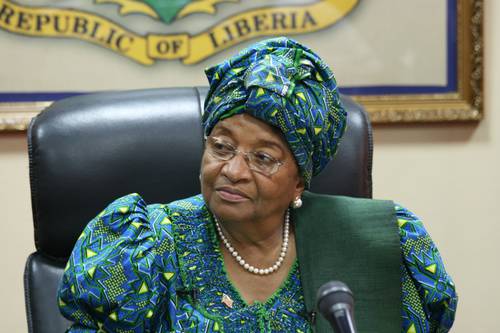
Liberians Still Hope For Peace As They Vote

Thousands lined up at the polling booths in Monrovia, Liberia's capital, for their first democratic transfer of power in 73 years.
Though Liberia is Africa’s oldest modern republic founded by freed U.S. slaves in 1847, its last democratic power transfer, defined as a peaceful handover at the end of a full term, was in 1943.
The outgoing president, Nobel Peace Prize winner and Africa's first female elected president, Ellen Johnson Sirleaf beat former soccer star George Weah to win the election in 2005 after a period of a transitional government following the civil war that ended two years earlier.
Johnson Sirleaf was praised by many Liberians for keeping the peace since the 14-year conflict when gangs of child soldiers, drugged and wearing ammunition belts ransacked through the streets.
Though preparations and voting have been peaceful, former rebel leader, Prince Johnson, is one of the 20 candidates, and the ex-wife of warlord Charles Taylor, now in a British prison, is the running mate of one of the favorites, George Weah, has raised some worry in the country.
Unlike Sierra Leone which had a U.N.-backed court for civil war-era crimes, Liberia has prioritized reconciliation over justice. This means that some of those involved in the war that killed a quarter of a million people are still prominent public figures.
“I am just voting for peace. We want peace right now, peaceful country, we want a peaceful situation now and things to go fine,” said James Marthics, a voter in Paynesville, a suburb of the capital Monrovia.
Some voters waited for hours before dawn to vote, bringing small wooden chairs with them and forming orderly queues as vendors sold them provisions. Early voting in Monrovia went rather smoothly, though there were delays in some areas.
“I need a change of this government that is in power,” said Richard Akoi, 32, a former child soldier who fought for Taylor’s rebels. “I‘m a die-hard fan of former president Taylor and if he shows up today in the election I‘m going to vote for him.”
Johnson Sirleaf urged Liberians to maintain the peace in an address to the nation on the eve of the vote.
“Embrace your neighbor, regardless of their political choice,” she said.
Though results are expected to begin arriving later this week, most analysts think it is unlikely that any single candidate will win a majority of votes on Tuesday, raising the likelihood of a run-off election in early November.
Among the candidates are the favorites such as: Vice President Joseph Nyuma Boakai of the ruling Unity Party known locally as a “countryman” meaning an indigenous Liberian; international lawyer, Charles Brumskine of the Liberal Party; and last but not least, George Weah, who played for AC Milan and Paris St Germain and was greeted at the polling station by lively supporters in football shirts.
Rebel leader, Prince Johnson, who was shown sipping a beer as he directed the torture of President Samuel Doe shortly before his murder in 1990 in an infamous circulated videotape, is considered to have only a remote chance of winning.
Roddy Barclay, director at risk advisory Africa Practice, said the participation of civil war-era figures was unlikely to lead to a “slide back into an era of warlord politics.”

Tinubu's 7-Point Agenda: Matters Arising By Pius Adesanmi

Here is a summary of Tinubu's 7-point agenda:
1) national industrial policy
2) infrastructure plan
3) tax credits and subsidies
4) credit-based economy
5) more electricity generation
6) government-backed home mortgage system
7) investment in agriculture
I find this amusing in Tinubu's address:
“We must realize that no populous nation has ever attained broadly- shared prosperity without first creating an industrial capacity that employs large numbers of people and manufactures a significant quantity of goods for domestic consumption or export.”
I find it amusing because it is a careful rewording of an axiom that is generally applied to education - specifically public education - in the developed parts of the world.
We say that no nation has ever attained modernity, prosperity, development, etc, without laying a solid foundation in public education. The quality of your growth and development is proportional to the quality of your public education.
In a seven-point agenda (Yar'Adua is not even acknowledged) that is totally silent on education, a popular axiom commonly applied to public education in civilization is reworked and repackaged for industrialization.
Who does not know that an under-educated or diseducated citizenry will make everything in this 7-point agenda a non-starter? They will start by selling off the paper on which Tinubu's agenda is written and use the money to buy gala and lacasera in order to have enough strength to scream for 24 hours in support Asiwaju and his ilk in the political leadership of Nigeria.
The ignorance of the people is the greatest wealth and the greatest asset of the Nigerian political elite.
Ask a Nigerian leader to choose between ten oil wells and mass ignorance of the people and you'll be surprised by his choice - if confidentiality were guaranteed.
That is why everything that has happened to the Nigerian education sector is by design. The rot is purposed and deliberate. Too many of our citizens exposed to what we teach their own kids that they send to us here in Euro-America is not in their interest.
I have a five-year-old in Grade One. The civics assignments she brings home every day from school are a constant source of considerable sadness for me. Assessing how they are shaping her mind, the sort of latitude for critical thought and citizenship sentience they are opening up to her at five is often too much for me to swallow. I wince and gnash my teeth in agony every time because I understand what they are building and preparing her mind for: the 21st-century world of the global knowledge economy and the future after that.
At five, she already owns the global knowledge economy in a philosophized system that is preparing her for competition from Chinese kids and kids from Dubai and Japan in the race for the future.
What they are pouring into this young mind is what will provide the genius and innovation to instrumentalize this 7-point agenda and deploy it for a holistic vision of a society of mutually beneficial commonwealth. The democratization of that commonwealth is at the centre of the philosophy she is being introduced to.
You destroy public education, normalize the concentration of 180 million people's wealth in your minuscule elitist class, groom a vast national confederacy of ignorance to defend the concentration of the commonwealth in your 1% percent rank of political elitism at their own expense, and then turn around to market agendas that can only work on a foundation of massive investment in public education for the next 30 years.
Woin!

Court Orders Police To Produce Evans’ Brother-In-Law

Justice Mohammed Idris of the Federal High Court in Ikoyi, Lagos, has ordered the Nigeria Police Force to produce in court the brother-in-law of billionaire kidnapper, Chukwudumem Onwuamadike, aka Evans, who has been held in detention for four months.
Evans’ brother-in-law, Okwuchukwu Obiechina, has been held in police detention for his alleged involvement with Evans' kidnapping case.
Mr. Obiechina’s lawyer, Olukoya Ogungbeje, said he has been detained by the police since June 2 and prayed the court to order his release from police detention.
The suit, marked FHC/L/CS/1050/20177, has Mr. Obiechina and his wife, Nzube, who is Evans’ sister, as plaintiffs.
They sued the Commissioner of Police in Lagos State, the Nigeria Police Force, and the Special Anti-Robbery Squad of the Lagos State Police Command.
Mr. Ogungbeje, who is also representing Evans, had on Friday appeared before Justice Idris with an ex parte application seeking an order to mandate the police to free Mr. Obiechina.
But rather than granting the ex parte application, Justice Idris directed the lawyer to put the police on notice, with an order that the police must produce Mr. Obiechina before him on October 12 to show cause why the order for his immediate release should not be made.
One Okoliagu Abunike, who deposed a 15-paragraph affidavit in support of the ex parte application, said Mr. Obiechina was arrested by a team of policemen led by two officers, identified only as Phillip and Christian.
Mr. Abunike argued that Mr. Obiechina was arrested and detained solely because of his relationship with Evans, adding that the police officers had been bragging that no court would order the release of Mr. Obiechina.
“Since June 26, 2017, the first applicant is still being detained at the detention cell of the respondents till date, even beyond the constitutionally allowed time by the Constitution of the Federal Republic of Nigeria,” Mr. Abunike said.
“The applicant has not committed any offense known to law to warrant his being arrested and detained by the operatives of the respondents.
“The applicant has not committed any offense known to law that will warrant the infringement of his right to life, personal liberty, fair hearing, freedom of movement and dignity of human person,” he argued.

Kenyan Opposition Leader Withdraws From Presidential Poll

Raila Odinga, the Kenyan opposition leader on Tuesday said he would not stand in a court-ordered re-run of August's presidential election that is scheduled for Oct. 26. Odinga says the polls would not be fair or free.
However, President Uhuru Kenyatta said the election would proceed as planned and he was sure that he would win again, despite his only challenger, Odinga withdrawing. Kenyatta also cited that the majority of his party won in both houses of parliament and among the country’s 47 governors.
“We have no problem going back to elections. We are sure we will get more votes than the last time,” Kenyatta said in the southern town of Voi on local television.
The announcements have prolonged the political uncertainty that has worried citizens and blunted growth in Kenya which is East Africa's biggest economy.
A nationwide protest has been scheduled for Wednesday by Senator James Orengo, who is a key ally of Odinga, raising the potential of violent clashes between police and protesters.
“Tomorrow all over the country there are going to be demonstrations the basis will be no reforms, no elections,” Orengo said.
After the 2007 presidential election, 1,200 people were killed in protests and ethnic violence. However, for now, there is little sign that the demonstrations could boil over into ethnic clashes.
Odinga criticized the Independent Electoral and Boundaries Commission (IEBC), for not replacing some officials, who he believes is responsible for irregularities in the August poll.
“Following the withdrawal of the NASA presidential candidate, the Commission and the legal team are meeting and will communicate way forward,” the IEBC said on Twitter after Odinga spoke.
“There is no intention on the part of the IEBC to undertake any changes to its operations and parts of the personnel to ensure that the illegalities and irregularities that led to the invalidation of 8th of August do not happen again,” Odinga told a news conference in the capital of Nairobi.
“Indications are that elections scheduled for the 26th of August will be worse than the previous one,” he said. “In the interest of the people of Kenya, the region and world at large, we believe that all will be best served by (opposition alliance) NASA vacating the presidential candidature of elections.”
On Sept. 1, the Supreme Court nullified incumbent Kenyatta’s win on Aug. 8 due to procedural irregularities and ordered a new poll pitting Kenyatta against Odinga to be held within 60 days.
Since then, teargas has been used repeatedly by police to disperse small protests by the opposition who demand that the election board changes some officials.
On Tuesday, opposition legislators boycotted the ruling party's session as they were debating proposed amendments to the election laws, which said if a candidate boycotted an election, the remaining candidate automatically wins.
The draft amendments require another reading and a presidential signature before they become law.
Ruling party legislators said that the amendments were designed to head off a constitutional crisis if Odinga pulled out of the election.

Re: Kemi Adeosun’s ‘Deconstructing The Debt Story’ By Oluseun Onigbinde

It is important that public officeholders clarify the issues that citizens are distraught about. One such issue has been the case of rising public debt. Kemi Adeosun's piece comes in the context of the well-rehashed situation that the current administration met upon taking office. With its hail of campaign promises without counting the cost, the Buhari-led government pushed itself into a tyranny of expectations. I guess Nigerian politicians will be more mindful when they make promises, as the campaign pamphlets had programs with at least N19tn yearly to fulfill.
We must also understand that the issue of debt is not treated with consternation, as Kemi Adeosun wrote. It is a right argument that requires our interest in inter-generational equity. If we are amassing the debt that will be a burden on future revenues, it is important to demand more transparency on what exactly we are bequeathing the future and the economic viability of it. Nigeria paid $13bn to settle the Paris Club of creditors mostly tied to frivolous infrastructure that had no economic impact on the current generation.
It must also be said that this administration has not been more transparent than previous governments as regards debt numbers. I reckon that DMO has to be one of the best-managed government institutions with how it maintains an updated register of the national debt. Several officers who worked at state governments where it is nearly impossible to get fiscal numbers and currently at the federal level are surprised at this level of transparency, but we must be vigilant that this not rolled back in a bid to silence varied discussions. Despite the anti-corruption crusade, it has become impossible to get a detailed breakdown of the N1.2tn capital releases as claimed for 2016 budget cycle. Except for NNPC that started its monthly operations and financial reports, this administration has not been more transparent than previous governments, and it needs to sincerely improve this. The Buhari-led government has not provided details of capital releases on the project basis, no bold attempts on open contracting, never applied punitive sanctions to those indicted in Auditor-General reports or any tangible thought on campaign financing, a drain on public resources at all levels. So which improved transparency are we talking about?
Diving into the numbers, the unfortunate thing about the current fiscal management is how it has not shown any belt-tightening approach in the way public officers parade themselves. We don’t know any radical approach to reduce aides of public officers nor has there been any interactive party-level discussions on the National Assembly to rein its cost. In a budget approved during the recession, it is still littered with purchase of cars at N25bn, computer software acquisition at N9bn etc. One would have expected that beyond the serial removal of ghost workers that has not lead to a single prosecution and has always been a public relations stunt for successive governments, the entire Nigerian budgets will solely prioritize not a cluster of administrative capital projects but developmental capital projects with direct impact on the people. The ballpark figure of N1.2tn thrown around has no public details. How can such amount be spent with serial commissioning of projects since the Kaduna-Abuja rail? This means Nigerians are probably not seeing it or certain persons are economical with the truth. Well, I can easily be proven wrong with clear definition of capital projects funded. We continuously hear of the Efficiency Unit as a “placeholder point” but no real understanding of its operations and savings that helped government fulfill regarding bureaucracy.
I am happy that with Kemi Adeosun’s argument, the Federal Government clearly sees where Nigeria’s fiscal problem lies. The critical challenge has always been the size of public revenues, too low for a country of our population and economic size. This is why we must not fetishize our debt-to-GDP numbers currently at 17.1%. That Nigeria has a huge GDP and has not been able to maximize public revenues from it attest to the poor appraisal of the current GDP structure or the approach we have taken that poorly discourage tax payments. From 29% debt-to-revenue ratio in 2014, the Federal Government has moved to 44.7% in 2016. This means that from every 100 Naira that FG receives, it spends 44 Naira on servicing debts. In a recent Pew Research study, it was stated that as at 2015, Brazil spent 42% of its revenue to service debts, being the highest in the world. This shows that while Nigerian debt size might be low, the cost of servicing debt is high among its peers. We must not fall for low debt-to-GDP figures; it is the single incomplete story. Bond interests have not toppled 16% in past year, and the badge that the Nigerian government flashes is that portfolio investors now savor our sweet debt. Who would not with cool interest rates and guaranteed exchange rate exits? The Nigerian government is running a cool social security for the Nigerians who can afford its debt, distorting incentives for the growth of private capital.
It is also unfortunate that FG is also crowding the banks of retail savers launching bond issuance capped at 12-13%. This excludes its Federal Government debt to CBN that has risen from N866bn in February 2015 to N5.189tn as at July 2017. Imagine a scenario at when there are multiple options of bonds and treasury bills at tax and risk-free rates, which bank would borrow to the private sector? In the 2016 Budget Implementation Report by the Budget office, it was stated that “Credit to government grew by 27.44% when compared with the end September 2016 figure of N3.66 trillion….Credit to the private sector (Cp) slumped by 2.93% to ₦21.98 trillion at end-December 2016 from ₦22.65 trillion at end-September 2016 indicating crowding out .”
Think of a country with the debt to the government at a faster pace than credit to the private sector that also needs private capital to reach growth rates of 7% in 2020 as stated in its Economic Recovery and Growth Capital (ERGP). It is also important that government rates have been private lending benchmark in Nigeria now around 25%. With this administration, the only business in town as been government. This administration made a chore out of commissioning private plants but underneath the numbers is a frustrated Nigerian who can’t get capital from the bank because fiscal management have disincentivized this. This is why conversations of debt should not be in size. It is how does FG reduce the cost of borrowing and most especially the domestic offerings that now touches every upper and middle class bracket of the society.
Nigeria’s debt service costs will reach N1.6tn in 2017, closing on its personnel costs of N1.8tn, this is the worry that should be triggering debates on well-structured quantitative easing not government out-borrowing everyone in the space. The current approach of substituting local debt with dollar-denominated debt is also faulty. What should be the purpose of raising external debt? With oil being our main foreign earner at 95% of receipts, is Nigeria not supposed to be borrowing for infrastructure or making investments to correct this imbalance that puts Nigerian currency on a wrong footing every time that oil markets go into a dip?
As stated in the Economic Growth Recovery Plan “Nigeria’s peers raise an average 16 per cent of GDP from non-resource taxes; Nigeria raises just 3 per cent (2015).” The plan also states a target to “increase tax to GDP ratio from the current 6 per cent to 15 per cent during the period.” With a targeted GDP of N137.331tn in 2020, we are talking about tax revenues of N20tn, which is nearly eight times the current total non-oil revenue taxes. This means Nigeria needs to at least multiply its taxes eight times to meet the 2020 target. Despite the efforts shown by Kemi Adeosun in the piece, it shows that it will always be inadequate without a proper reflection on why do we have a huge GDP but little taxes? What is the structure of the GDP that makes it impossible to collect taxes? Has the Nigerian government shown enough faith in the management of public taxes that make it more deserving? These are the conversations that need to be honked because the current approach is a reflection of growth rates in the past and shows that without robust thinking our public revenues will not rise.
I believe the debt debate is rooted in the fact that Nigerian government is taking the escapist approach, racking up debt in quick numbers, rapidly forgetting where before exit of creditors. This escapist approach of taking gradual steps on revenue but giant footsteps on debt is what is being questioned. Nigerian leaders in 18 months have shopped everywhere - AfDB, World Bank, retail savers, bondholders, Eurobond, portfolio investors, Sukuk bonds, treasury bills to pay its own cost. A dive into its budget implementation reports shows that its numbers doesn’t add up such as how did Nigeria finance actual deficit of N1.02tn for 2016 after counting at bond receipts. How is FG also entitled to Paris Club refund and what is the source of the N1.64tn extra-statutory fund provided to states?
In fact, most of the projects tied to these debts especially rail do not have any known economic importance and are not fastened to the idea that such projects should be self-liquidating. They are mainly for political expediency, and this is why this debate is necessary. The Nigerian government should provide effective plumbing in raising revenues, rein on debt service costs with favor for long-term bonds as well as rates that consider private sector lending, evidently reduce overheads and administrative capital items and overall unleash transparency on every issue. Here we see monetary authorities (CBN) limiting liquidity in a bid to keep Naira at a preferred value by mopping up funds in circulation through borrowing, the fiscal authorities (government) keeps feasting on expensive debt while everyone except their bondholders leans through. The Nigerian government needs a lot of rigorous thinking as well as caution.

Mugabe creates new role of Minister of cyber security and threat detection as he gets more 'worried' about rise of social media


Mugabe creates new role of Minister of cyber security and threat detection as he gets more?
Zimbabwean President Robert Mugabe has created and  appointed a minister of cyber security and threat detection as the country deals with the growth of social media and internet-based media groups.

Mugabe and his family have accused the media of spreading "fake news" while Patrick Chinamasa who has been given the new post warned last month that the government would treat social media as a security threat.

Chinamsa, a lawyer, would be responsible for introducing a cyber crimes bill to criminalise the posting of false information on the internet, revenge porn, cyber-bullying and online activity against the government.

Zimbabwe's media laws are repressive, but the government has been struggling to regulate them because some of the media outlets are not based in the country.

Retired footballer David Beckham earns 'more than a £1million a month and pays himself £35k a day - Revealed


Retired footballer David Beckham earns
Despite retiring from football four years ago, It has been revealed by The Sun that England football legend and businessman, David Beckham, pays himself  £35,000 every day and earns more than £1million a month.
According to the reports, the 42-year-old father-of-four who is equally a model, withdrew a £12.7million salary from his image rights company in 2016, and he's still currently enjoying bankable deals with H&M, Adidas and Haig Club whiskey.
David's worth is estimated at £165million while he has gathered dividends of £45million over the past five years. He is still ranked among the top earners in the Premier League.
Following the financial findings, David's London-based Footwork Productions Ltd reported a £6.28million loss of sales in 2016, taking the company's overall turnover from £14.3million to £8.02million.
According to Companies House records, his business has now £263,000 in assets in comparison to his weighty £7.21million in 2015. While the records also highlight that the former England Manchester United footballer paid £1.43million in tax on his income. 
David Beckham who is one the most decorated and successful footballers in the history of football announced his retirement on the 16th of May 2013 Retired footballer David Beckham earns

N1.62bn Fraud: Dariye Finally Closes Case

Kanu Agabi, SAN, the new counsel for Senator Joshua Dariye, on October 10, 2017 finally closed the case of the defense, bringing to a closure a defense that began on June 10, 2016.
Agabi who was used by Dariye to replace G.S. Pwul, SAN, his former counsel who withdrew in March, told Justice Adebukola Banjoko, that the defense was ready to address the court.
“My lord, I am pleased to inform your lordship that we are closing the case for the defense and will like to address you,” Agabi said.
The prosecution, led by O.A. Atolagbe, raised no objections.
“We have no objection to that, and we are also grateful to address your lordship,” Atolagbe said.
Atolagbe, thereafter, urged the court to vacate a subsisting order, based on the request of the defense when it was led by Pwul, asking for the recall of the first prosecution witness, Musa Sunday, an EFCC operative, who was also present in court.
The defense raised no objections to the oral application of the prosecution.
“The order is hereby vacated,” the trial judge ruled.
 Justice Banjoko, thereafter adjourned to December 7, 2017 “for adoption of written addresses”.
It will be recalled that the trial of Dariye, a former Plateau State governor, began on July 13, 2007, but he had proceeded to the Supreme Court to quash the 23-count charge preferred against him, for defrauding the state of about N1.6 billion. The Supreme Court, however, dismissed his application on February 27, 2015 and ordered him to go face his trial.
Dariye’s trial recommenced on January 25, 2016, with the prosecution having so far presented 16 witnesses, including Peter Clark, a former UK Met Police, who investigated him in the United Kingdom.

Buhari Writes Senate, Seeks Approval For 5.5 Billion Foreign Loans

President Muhammadu Buhari has written to the Senate, seeking approval for $5.5 billion external borrowings.
The request was contained in a letter to both chambers of the National Assembly, which was read by the Senate President, Bukola Saraki, at the plenary on Tuesday.
The letter read in part: “Accordingly, the Senate is requested to kindly approve the following external borrowings: Issuance of $2.5bn in International Capital Market through Eurobonds or a combination of Eurobonds and Diaspora bonds for the financing of the Federal Government of Nigeria’s 2017 Appropriation Act and capital expenditure projects in the Act."
"Issuance of Eurobond in the ICM and/or loans syndication by the banks in the sum of $3bn for refinancing of maturing domestic debts obligations of the Federal Government of Nigeria, while looking forward to the timely approval of the National Assembly to enable Nigerians to take advantage of these opportunities for funding.

Airport Concessioning: Unions Accuse Bi-Courtney Of Owing FAAN N2bn, Threaten Strike

Aviation unions have accused Bi-Courtney Aviation Services Limited (BASL), operator of the Murtala Muhammed Airport Two (MMA2), Lagos, of owing the Federal Airports Authority of Nigeria (FAAN) over N2 billion arising from the concession agreement it entered into with the federal government in 2007.
The unions also issued a 15-day ultimatum to the Minister of State for Aviation, Senator Hadi Sirika, to revert the impending concession of the two airports in the first phase or face strike action, which would paralyze the entire aviation industry.
Speaking at a press conference organized at the Murtala Muhammed International Airport on Tuesday, leadership of the National Union of Air Transport Employees (NUATE), Air Transport Senior Staff Services Association of Nigeria (ATSSSAN) and the National Union of Pensioners (NUP), declared that since the commencement of the Build, Operate and Transfer (BOT) scheme in 2007, the terminal operator has not paid the FAAN.
NUATE General Secretary Olayinka Abioye, who spoke on behalf of all unions present, said BASL has accrued a debt of over N2 billion comprising of various fees for services rendered to it by the FAAN.
He provided the following breakdown of debts owed by BASL: aviation security, N1.2bn; management fees, N331m; fire and safety, N131.2m; marshaling service, N2.1m; electricity, N439m; rent and conference, N87.8m; and hotel fees, N116.9m.
“As these magnitudes of debts outstanding against Bi-Courtney are yet to be settled in favor of the FAAN, how can we guarantee that the federal government of Nigeria, through our ministry, will not unleash another monster on the FAAN in the name of concession?” Mr. Abioye said.
“Until matters such as this are resolved, aviation unions shall not rest on their oars and allow these shenanigans to continue. If we really and genuinely desire a business model that can fit our expectations, we should think of other models, such as the Green Field model, which empowers new investors with deals on fresh ventures, including construction of new runways, terminal buildings and so forth to be operated for a specified period of time before it is handed over to the government, or the corporatization model.
“Why not allow the airports to run as commercially oriented profitable concerns with accountability to shareholders, who may be government agencies or private investors? We had canvassed for the full commercialization of the FAAN long ago, albeit without the usual political, ministerial, presidential, or official meddlesomeness and interference, which has been the bane of lackluster performance and failure of the aviation system in Nigeria.”
The unions also charged the government to disband the Transaction Advisors (TA) it set up to midwife the concessioning of the airport in the next 15 days or face total grounding of the aviation industry.
The unions also advised the federal government to kick-start the concession exercise with one or two underutilized airports as a pilot scheme, noting that if the pilot project was successful, it could be replicated in other airports across the country.
“When these other airports become a success story as envisaged by the government, then, and only then, can the idea of sharing the big four be entertained,” the unions added.

Israel Pledges Improved Relationship With Nigeria

The Israeli Deputy Ambassador to Nigeria, Nadav Goren has reassured a steady promotion of business and economic ties with Nigeria to improve people-to-people relations between both countries.
Goren, who spoke to newsmen in Abuja on Tuesday, said the relationship between both countries was not religious, but economic and trade.
“Most may think the Israel-Nigeria relationship is based on tourism through the pilgrimage programmes but it is not that at all, in fact, Israel tries to work and maintain a relationship with Nigeria without looking at religion."
“Israel is focused on helping Nigeria attain economic development, so we have continued to train professionals and share our vast knowledge in key areas with Nigerians to attain this development."
“There are many Israelis in Nigeria, who manage and operate companies that focus on agriculture, water management and security which we feel are key for Nigeria’s development, especially as the Nigerian government has stressed on the agricultural sector."
Goren said Israel had been able to manage its scarce resources by carrying out researches that could be beneficial to Nigeria.
“Israel is a humble country with a population of about eight million people and we are known not to be blessed with natural resources, however, that has pushed us to research ways to recreate and manage the little resources we have."
“Israelis are now known as people who create opportunities in adversity, so it will be right to say we have been blessed with knowledge and will continue to share this knowledge with Nigeria."
“A classic example of the knowledge development of Israel is in our water management technology."
“Israel is known to have two-thirds of its land as arid causing us to struggle with water which led to a struggle with vegetation and agriculture."
“We carried out studies on ways to solve the problem and manage water and we were successful with it bringing about the water management technology we are sharing with Nigeria now."
“We know there are some parts of Nigeria that are struggling with similar conditions and those regions will benefit from this technology," he said.
The ambassador also said that the Israeli government had made provisions to introduce Nigeria to their water management technology in order to help Nigeria manage agriculture and water scarcity.
“In September, we had a delegation of senior government officials from Nigeria attend the 2017 Water Technology and Environmental Control Exhibition & Conference (WATEC) in Israel."
“We needed the delegates to see first-hand how the technology came about and how it works so that it could be properly replicated in Nigeria."
“This water management technology goes hand in hand with our focus on the agricultural sector as water is fundamental for successful agriculture which is something we have also been successful with and are proud of."
“The Nigerian government has stressed on its plan to develop the Nigerian agricultural sector so we are happy to support the government with the necessary knowledge and technology to attain that."
“These are measures we are taking to strengthen the relationship between our countries," Goren said.
The Israeli government is also taking steps to contribute to the improvement of the education, health and energy sectors in Nigeria.
The Israeli Embassy in Nigeria did not celebrate its 2017 national day as officials decided to donate the funds for the celebration to the Internally Displaced Persons (IDPs) camps in Adamawa.
The embassy organized a football tournament for the children in the camps and awarded a one-year full scholarship to 225 children as part of efforts to support the children and expressed the hope to continue such humanitarian gestures.